Volatile demand, capacity crunches, labour shortages, rising fuel prices, sustainability pressures, and customers who now expect “Amazon-level” delivery as standard.
If this sounds familiar, you’re not alone. Logistics and supply chain teams across Canada and around the world are feeling the pressure from every direction. These changes are why artificial intelligence (AI) in logistics has become one of the most valuable tools for companies trying to stay competitive.
AI in logistics isn’t just a buzzword anymore. With proper integration, it’s a practical, measurable way for logistics companies to improve forecasting, routing, warehouse operations, and customer communication.
As technology advances, businesses are adapting AI not for experimentation, but for real operational gains that eliminate waste, reduce delays, and strengthen the entire supply chain.
Research by Oracle and McKinsey indicates that early adopters of AI-powered supply chain management software have achieved approximately 15% lower logistics costs and 35% better inventory levels compared to their slower-moving peers.
A 2024 survey of manufacturing CEOs by Zogby Strategies and Xometry revealed that 97% expect to be using AI in their operations within two years, underscoring how quickly AI in supply chain and logistics is becoming the norm rather than the exception.
In other words, your competitors are either already experimenting with AI or they’re planning to.
In our latest blog post, we break down five practical ways AI in logistics improves supply chain efficiency, providing real-world examples and a focus on what matters if you’re responsible for shipping, transportation, or end-to-end supply chain management.
What Do We Mean by “AI in Logistics”?
When we talk about artificial intelligence in logistics, we’re talking about a stack of technologies that work together:
- Predictive/traditional AI: machine learning models that forecast demand, predict ETAs, or detect anomalies.
- Generative AI: large language models that can summarise shipment exceptions, generate customer emails, or draft documentation.
- Operations research and optimization: mathematical models for routing, network design, and capacity allocation, now increasingly combined with AI.
In practice, AI in logistics and supply chain management is applied in various stages, including demand forecasting and inventory optimization, route planning, warehouse automation, and more.
Let’s look at five areas where the benefits of AI in logistics are both tangible and measurable.
1. Smarter, More Accurate Demand Forecasting
Traditional forecasting methods can sometimes struggle when demand becomes unpredictable. AI models take in far more data, including historical trends, seasonality, promotions, external events, weather, and even market sentiment. They then use this data to detect patterns humans miss.
Using AI in this way results in more accurate, real-time demand predictions, which allow logistics and operations teams to:
- Reduce stockouts and overstocks
Lower carrying costs - Improve order fill rates
- Allocate resources more precisely
AI-powered logistics platforms enable companies to identify at-risk orders early, adjust their fulfillment plans, and prevent delays before they occur.
Real-world example: AI tools now help manufacturers proactively prioritize products with the most significant impact on customer satisfaction or profitability. This minimizes reactive fixes and supports companies in maintaining service standards during demand swings.

2. Route Optimization & AI-Driven Transportation
Transportation accounts for a major portion of logistics costs. AI enhances routing efficiency by analyzing real-time traffic, weather, capacity, and delivery constraints, making it much more efficient than manual planning.
MIT highlights Uber Freight’s use of machine learning to reduce empty miles from ~30% to just 10–15%, a significant improvement in cost and sustainability.
Generally, AI can enhance transportation planning through:
- Dynamic rerouting during disruptions
- Better ETA accuracy
- Improved truckload utilization
- Mode optimization (truck vs. rail vs. intermodal)
According to the World Economic Forum, approximately 15% of trucking miles are driven empty. Based on what we know about AI, it’s an inefficiency that this powerful technology is well-positioned to address.
Impact for shippers: Your team makes fewer reactive decisions, spends less time rescheduling freight, and moves more product with fewer kilometres and fewer trucks.
3. Warehouse Efficiency With Robotics & Computer Vision
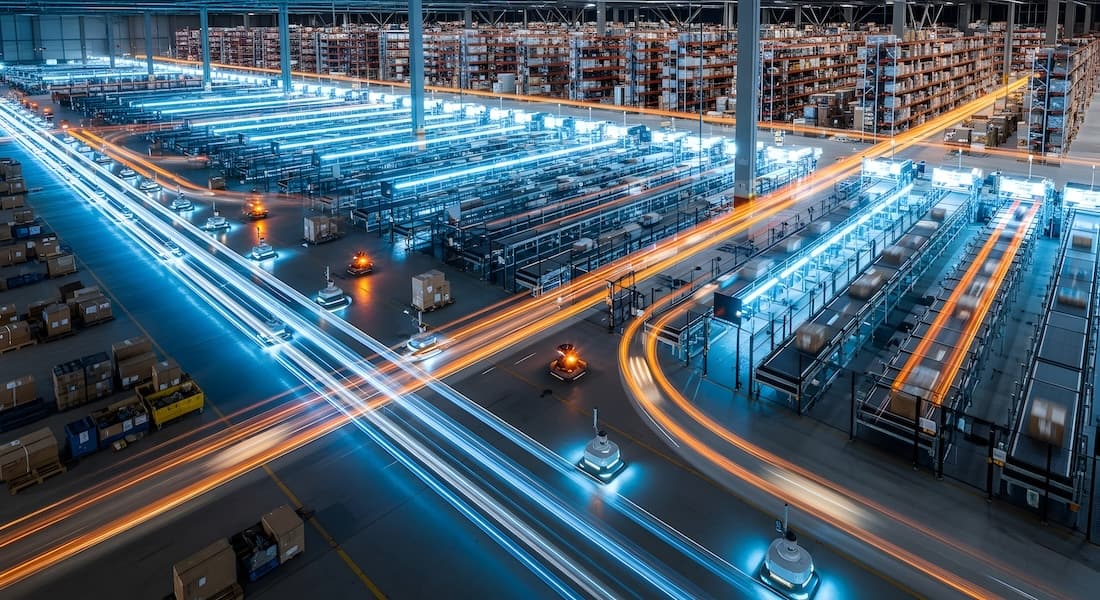
AI-powered robots can effectively manage repetitive and high-volume tasks such as picking, sorting, and transporting goods. In turn, these same robots can optimize workflows, navigate intelligently, and collaborate effectively with human teams to achieve higher throughput.
Amazon, for example, deploys over 200,000 robots in its facilities to speed up pick times and handle peak-season surges.
Computer Vision Boosts Accuracy
Computer vision systems use cameras and AI models to keep warehouse operations accurate and consistent. They can identify damaged goods, detect incorrect or missing labels, verify item counts in real time, and flag quality issues before anything ships out.
DHL notes this as one of the fastest-growing AI trends because it minimizes human error and promotes a safer, more reliable warehouse environment.
Why it matters: Fewer picking mistakes, fewer returns, faster packing workflows, and better inventory accuracy. All of that without needing to scale headcount at the same rate as volume.
4. Real-Time Supply Chain Visibility & Risk Management
Modern supply chains are global, fragile, and often disrupted by weather, strikes, port congestion, or geopolitical events. We are seeing many of these events in our current climate.
AI helps teams anticipate problems instead of reacting to them late.
AI can combine internal and external data, such as weather alerts or route shutdowns, to flag at-risk shipments early. This technology is also able to:
- Predict disruptions before they escalate
- Recommend alternative routes or modes
- Prioritize critical shipments
- Automatically notify customers of updated ETAs
Generative AI is increasingly used for scenario modelling, allowing teams to test “what if” situations (e.g., port closure, supplier delay) and prepare backup plans.
Outcome for businesses: More predictable performance, fewer surprises, and a more stable customer experience, even when external conditions shift.
5. Back-Office Automation & Faster Customer Communication
BCG reports that logistics companies using AI agents for documentation (RFPs, customs forms, contract drafts) often see a full ROI within 18–24 months.
This demonstrates how AI in logistics can deliver immediate, tangible value, not just by reducing costs, but by streamlining workflows that typically drain time and create backlogs.
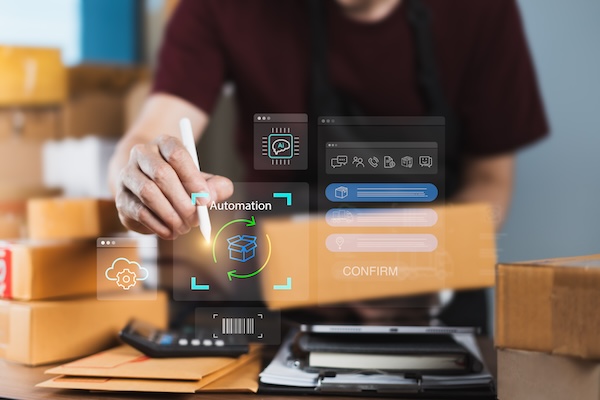
AI tools can now read, extract, and organize data from essential documents, such as bills of lading, invoices, customs declarations, rate sheets, and order acknowledgments. Instead of manually entering or verifying this information, AI handles the repetitive work in seconds.
On the customer service side, AI-powered chatbots and digital assistants help manage routine inquiries such as shipment tracking, delivery updates, simple support questions, and order status checks. These tools provide instant answers and keep customers informed without tying up your staff.
The real benefit is the balance it creates: customers receive faster, more consistent communication, while your team regains the time needed to handle exceptions, solve real problems, and focus on higher-value priorities rather than paperwork.
Is AI Taking Over Logistics?
No—AI isn’t replacing logistics teams. It’s removing the repetitive, manual work that slows them down.
AI, generative AI, and classic operations research are meant to work together, not replace human decision-makers. Humans still guide strategy, manage relationships, and handle exceptions.
AI is simply giving teams better tools to operate a more complex supply chain without burning out.
Key Takeaway: Use AI in Logistics to Stay Competitive
AI in logistics is now an established, effective method for companies to improve efficiency, cut costs, and achieve higher accuracy.
From improving demand forecasting and routing to enhancing warehouse operations and streamlining documentation, AI empowers logistics teams to work smarter and move faster.
The companies adopting these tools today aren’t just getting ahead; they’re setting the new standard for what modern supply chains should look like.
If you’re looking to strengthen your supply chain, improve visibility, or reduce the operational strain on your team, you don’t have to navigate AI alone. WTC Group can help support you with a plan tailored to your workflow, aligning with your business goals and leveraging AI in ways that make the most sense for your logistics needs.
Contact our team to discover how a partner who understands both the technology and the complexities of your supply chain can help drive your business growth and long-term success.