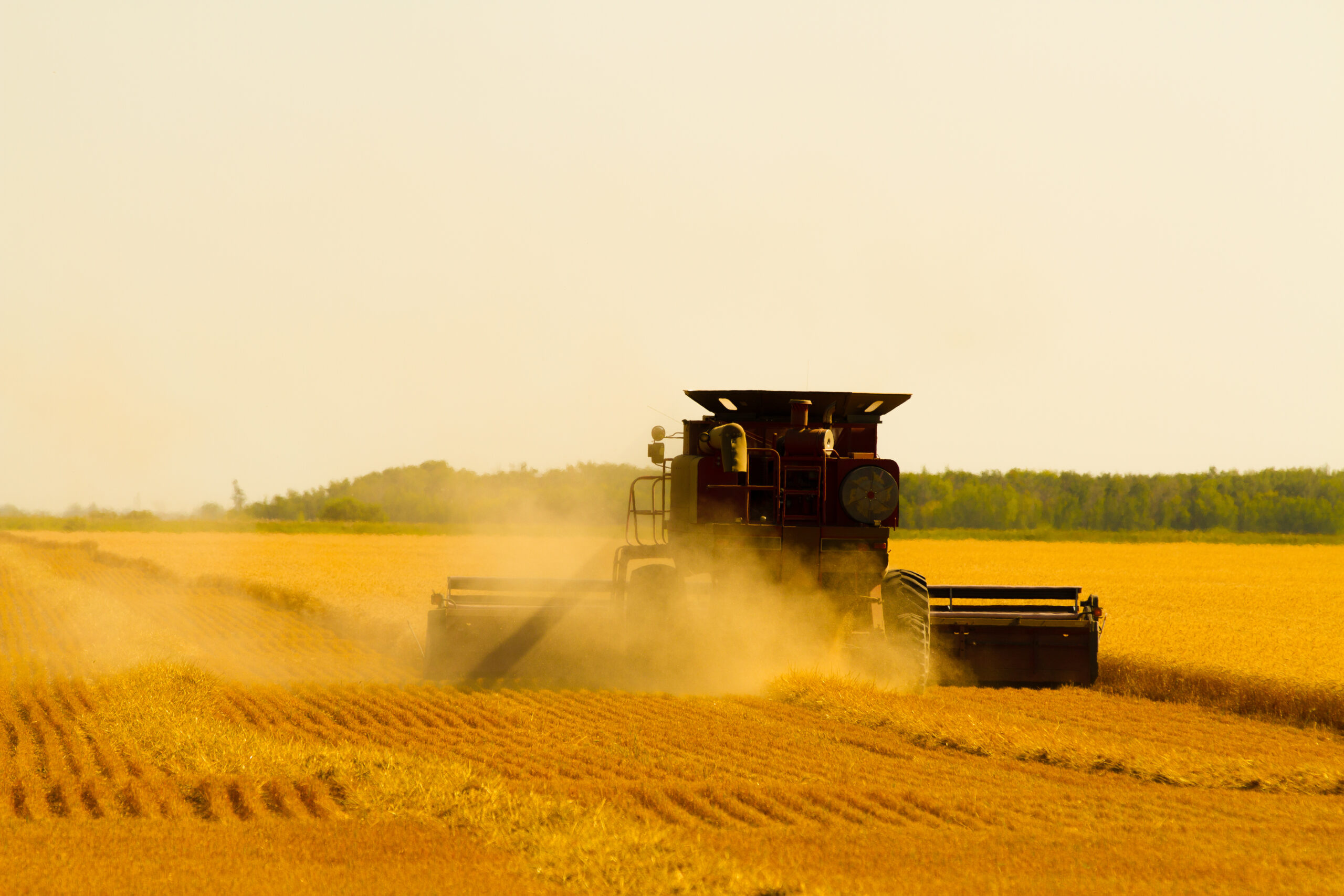
Every grain harvest carries a note of uncertainty until the last field is off, but by late summer, that uncertainty usually narrows into a clearer picture for Saskatchewan and Alberta. Spring seeding conditions, summer rainfall, and the pace of crop development all feed into a running forecast of what this year’s wheat, durum, and pulse crops will look like once combines start rolling. For the exporters and logistics teams who move that grain to market, those early signals matter just as much as the final numbers.
That’s because grain logistics planning doesn’t wait for harvest to finish. Rail car allocations, terminal scheduling, and storage decisions are typically locked in weeks ahead of peak volume, based on the best available read of how big, how early, and how wet this year’s crop is shaping up to be. Wait too long to start that planning, and even a strong harvest can turn into a bottleneck once everyone else is trying to move their crop at the same time.
This blog looks at what the latest harvest expectations in Saskatchewan and Alberta suggest, why that outlook changes the logistics equation for exporters, and what to confirm with a transloading partner before the rush hits. Whether you’re shipping wheat, durum, or pulses, the underlying planning questions are largely the same.
What This Year’s Harvest Expectations Look Like in Saskatchewan and Alberta
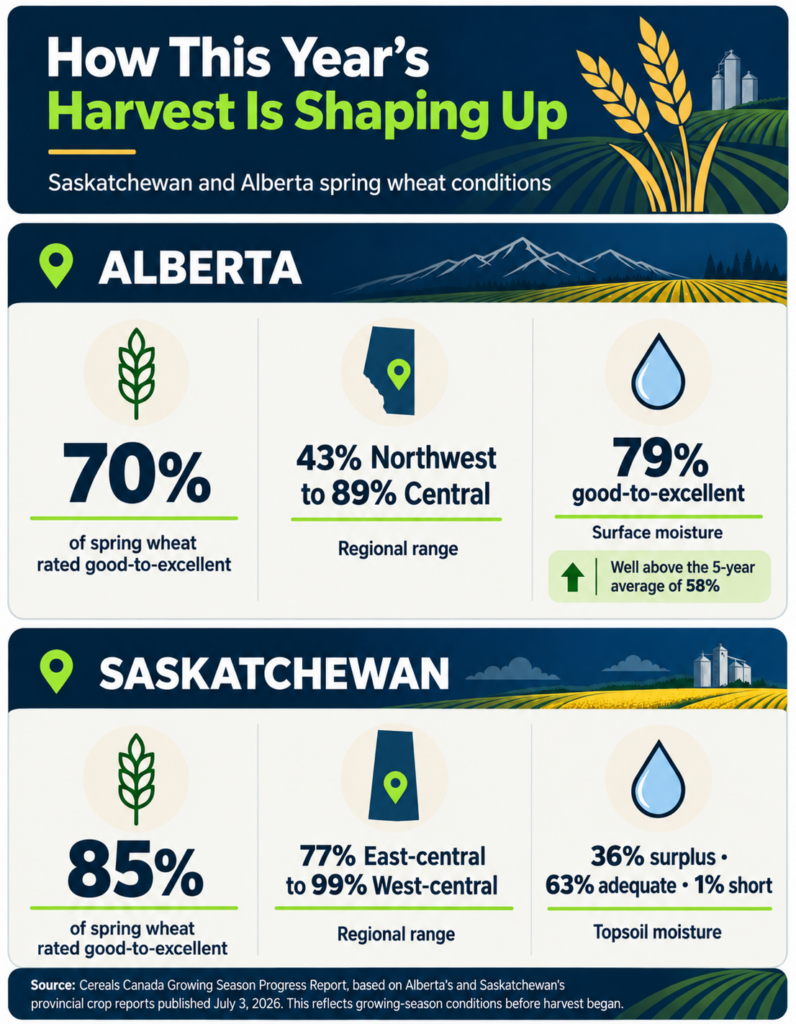
Cereals Canada tracks growing season progress across the Prairies through its Growing Season Progress Report, which compiles wheat data from the official crop reports published by the governments of Alberta, Saskatchewan, and Manitoba, and refreshes on a bi-weekly basis through the growing season. It breaks the season into provincial highlights, so anyone trying to get a read on harvest expectations can see how conditions compare region by region, not just province by province.
As of the most recent reports available while this brief was prepared (Alberta’s crop report and Saskatchewan’s crop report), the two provinces were telling somewhat different stories. In Alberta, 70 percent of the spring wheat crop was rated good to excellent, with surface moisture running well above both the five- and ten-year averages, though the pace of crop development was lagging slightly behind normal for this point in the season. In Saskatchewan, about 85 percent of the spring wheat crop carried a good-to-excellent rating, but conditions varied sharply by region: parts of the east-central area had received enough rain to saturate fields and flood low-lying land, while the west-central region was reporting some of the best ratings in the province.
Since this snapshot was captured, both provinces have moved from the growing season into harvest. As of Cereals Canada’s most recent update, Saskatchewan’s harvest was sitting at just 4 per cent complete, well behind its five-year average of 15 per cent for this point in August. That shift from growing-season conditions to an early, slow-moving harvest is exactly the kind of signal that should be feeding into logistics planning right now.
That same Cereals Canada tool also tracks Manitoba, and it’s worth knowing that context exists if a reader goes looking for it. But the logistics implications that matter most to WTC Group’s exporters run through Saskatchewan and Alberta, so this article stays focused there.
It’s also worth remembering that a good-to-excellent rating on spring wheat doesn’t tell the whole story for every commodity moving through the Prairies. Pulse crops respond to moisture and heat differently than cereals do, and durum in particular can see quality swings that wheat doesn’t. Anyone using these provincial reports to plan grain transportation should read them as a directional signal, not a finished forecast, and should keep checking back as the season progresses toward harvest.
Why Harvest Timing and Volume Change the Logistics Equation
A grain harvest that comes in early and heavy puts pressure on the export system in one direction. A harvest that’s delayed by wet weather, like the flooding reported in parts of Saskatchewan this season, puts pressure on it in another. Either way, the numbers coming out of provincial crop reports translate directly into decisions further down the supply chain, often before a single combine has finished a field.
A few of the ripple effects worth watching as harvest expectations firm up:
- Rail car allocation gets tighter. A larger-than-expected crop increases competition for hopper cars just as multiple provinces and multiple commodities are all trying to move grain at the same time.
- Terminal scheduling shifts. Ports and inland terminals plan throughput around expected volumes, and a harvest that runs ahead of or behind schedule can crowd or empty those windows unpredictably.
- Storage timing becomes more important. Producers and handlers need a realistic sense of when grain will actually be ready to move, not just how much of it there will eventually be.
- Weather-driven quality issues change handling requirements. Saturated fields, like those reported in Saskatchewan’s east-central region, can affect grading and may require different blending or handling once the crop reaches a terminal.
- Grain transportation plans made in July often need revisiting by September, once actual harvest conditions, rather than early-season projections, are known.
- Export documentation and scheduling windows can shift too. A crop that comes off the field faster than expected can compress the timeline for customs paperwork, vessel bookings, and buyer commitments downstream.
None of this is new to anyone who has worked through a harvest season before. But it’s exactly why the planning conversation needs to start while the crop is still in the field, not after the trucks are already lined up at the elevator. A logistics partner who is only reacting to volume once it shows up at the terminal is always going to be a step behind, and that gap tends to show up as delays, demurrage, or missed vessel windows further down the chain.
What Exporters Should Confirm With Their Logistics Partner Before Peak Season
For companies managing Canada grain exports, peak harvest season is not the time to discover a gap in capacity or communication. The busiest weeks of the year are also the least forgiving ones: everyone is trying to move volume at once, and a logistics partner who hasn’t planned ahead has very little room to absorb surprises. A short list of questions worth confirming with a logistics or transloading partner well in advance of harvest:
Rail car commitments
Has capacity been reserved for your expected volume, and what happens if the crop comes in larger or later than planned?
Terminal scheduling
Is there a confirmed window for your shipments, and how much flexibility exists if that window needs to move?
Bulk versus bagged or containerized capacity
Does your partner have the flexibility to handle your product the way your buyers need it received, whether that’s bulk-to-bulk, bulk-to-bag, or bag-to-bag?
Contingency planning
What’s the plan if weather delays harvest, or if quality issues require different handling than originally expected?
Communication cadence
Who is your point of contact during peak season, and how often will you get updates on where your shipment actually stands?
Track record with your specific commodity
Has your partner handled the volume and grade of grain or pulses you’re shipping before, or would you be their test case during the busiest weeks of the year?
Working through these questions before harvest is underway gives exporters room to adjust if conditions change, rather than scrambling to react once volume is already moving through the system. It also tends to surface gaps early, while there’s still time to fix them, instead of during the first week of peak volume when everyone’s attention is stretched thin.
How WTC Group Supports Grain and Pulse Exporters Through Harvest Season
This is exactly the kind of planning WTC Group works through with grain and pulse exporters every season. Our transloading capabilities cover containerization from bulk-to-bulk, bulk-to-bag, and bag-to-bag, which means we can match how your product moves to what your buyers actually need on the receiving end, rather than forcing every shipment into the same process.
WTC Group manages roughly 25,000 to 30,000 TEU annually in partnership with leading agribusinesses, giving us the operational depth to absorb the volume swings that come with an unpredictable harvest instead of being caught off guard by them. Because our facilities sit on the Vancouver gateway, we’re positioned to help Prairie exporters connect their crop to international markets without adding unnecessary handling, delay, or cost along the way.
That matters most when harvest timing doesn’t go exactly to plan, and this year’s numbers suggest exactly that: Saskatchewan’s harvest is already running well behind its five-year pace. Our team works directly with exporters and their supply chain officers throughout the season, not just at booking time, so plans can be adjusted as real harvest conditions replace early-season projections.
Harvest expectations will keep shifting between now and the time combines finish rolling across Saskatchewan and Alberta, and that’s normal for this time of year. What matters more is having a logistics partner who can adjust with the season instead of reacting after the fact. WTC Group has spent years helping Prairie exporters move grain and pulses efficiently, no matter what a given grain harvest brings. Get in touch with WTC Group to talk through your logistics needs ahead of this year’s peak season.